
Can you tell when a video in your social media feed was made by AI? If you’re like most people, probably not.
According to CNET, while 94% of users believe they’ve encountered AI content online, only about 44% feel confident spotting AI-generated content. No wonder outlets like NPR are discussing ways to spot AI in your feeds — and why social platforms are starting to establish AI disclosure rules. From TikTok to Instagram, creators are increasingly required to disclose realistic AI-generated or altered content, with the platforms even adding labels automatically to protect viewers and build trust.
That labeling sends a clear signal: social platforms are accepting AI-generated content as part of the media landscape. For brands, that raises big questions. Should you experiment with AI-generated videos? What are the benefits and the harmful effects? And beyond the hype and the panic, are AI-generated videos even performing well? Let’s find out.
What AI-Generated Videos Look Like on Social Today
AI-generated videos can be found on every social platform, but they’re far from uniform.
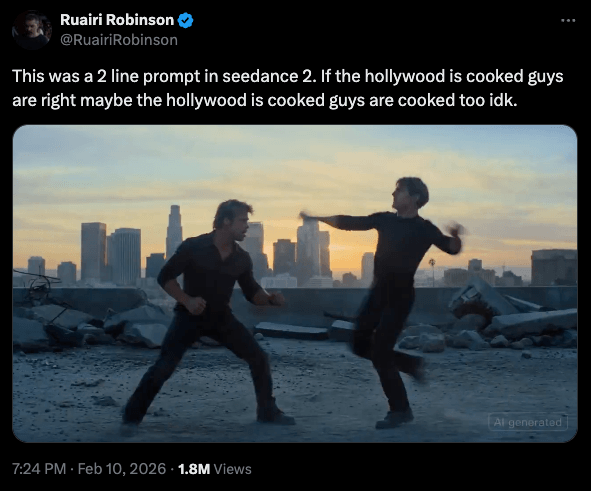
Some clips are shockingly realistic, like this video of “Tom Cruise” and “Brad Pitt” fighting on a rooftop that’s racked up more than 1.8M views on X so far. Posted by Oscar-nominated filmmaker Ruairí Robinson and created via a two-line prompt into AI service Seedance 2.0, the video and Seedance were condemned by actors’ union SAG-AFTRA, which slammed the “unauthorized use of our members’ voices and likenesses.”
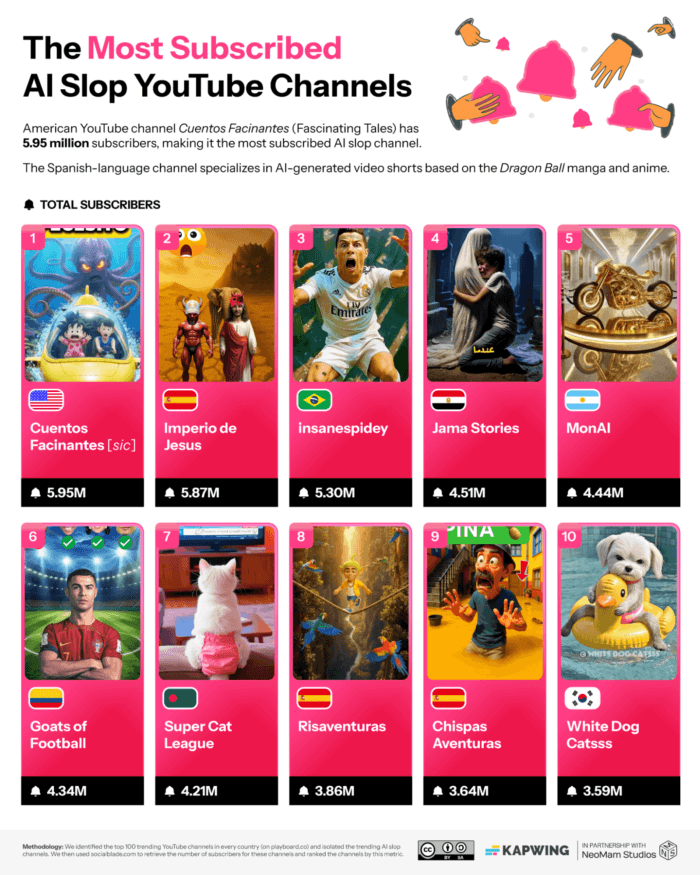
And then you have the other end of the spectrum — what many are now calling “AI slop.” The term refers to low-quality, nonsensical, or oddly distorted videos mass-produced by AI to generate views and clicks. New research by Kapwing found that nine of the top 100 trending YouTube channels in the U.S. were dedicated to AI slop, with these accounts’ subscriber count totaling 14.47M.
AI-generated content is also being used as promotional content. Industries like skincare and cosmetics are seeing a surge of AI influencers and synthetic demonstrations. American Salon notes that brands are experimenting with AI models to promote products, though the line between real and artificial is becoming increasingly blurred.
In other words, AI video is a mix of extremes: on one side, hyper-realistic clips that push boundaries; on the other, mass-produced, “sloppy” content that veers towards the ridiculous. For brands and creators, the challenge is knowing which side of the spectrum to engage with — and whether audiences will even respond the way they hope.
Top Tools Being Used To Create AI-Generated Videos
So how are these videos even being created? It comes down to a growing stack of AI tools:
- Text-to-video generators. These tools turn written prompts into fully rendered video scenes. Creators can describe a scenario, and the AI generates the visuals, clips them together, and sometimes even adds audio. Tools frequently mentioned in roundups include Sora by OpenAI, Veo 3 by Google, and Runway.
- AI avatar & talking head tools. Typically used for explainers, ads, and social content, these tools create realistic digital presenters that read scripts aloud. Popular tools include Synthesia and HeyGen.
- Image-to-video & animation tools. These platforms animate still images or extend short clips with motion effects, often used for stylized or surreal content. Tools like Pictory and Vyond fall into this category.
- All-in-one editing suites with AI features. Traditional video editors are now layering in AI for tasks like background removal, clipping, and captioning. Platforms such as Wondershare Filmora and OpusClip incorporate AI into standard editing workflows.
What once required a full production team can now be done with a handful of AI tools, often requiring just a prompt and a few clicks. But what does that kind of accessibility actually lead to? That’s where things get complicated.
The Good, the Bad, and the Ugly of AI-Generated Videos
The Good: Accessible Content Creation
For creators and brands, the biggest upside of AI video is simple: it lowers the barrier to entry.
What used to require a full team can now be done by a small group — or even just a single creator — in a fraction of the time. For brands, that means faster turnaround times and the ability to scale content output without significantly increasing budgets. In fact, teams using AI video tools report creating 5x to 10x more content with the same resources.
As a result, smaller brands and solo creators can now compete in ways that weren’t previously possible — and they’re leaning in. According to Fiverr, demand for freelancers skilled in AI video creation rose 66% in the second half of 2025 alone. Meanwhile, more than 80% of creators now use AI at some stage of their workflow.
In that sense, AI acts as a creative equalizer. It opens the door for more experimentation and a wider range of voices — all without the traditional time and cost barriers of video production.
The Bad: Low-Quality Content and Legal Battles
The same accessibility that makes AI video appealing also creates serious downsides. When anyone can create content at scale, not all of it is worth watching.
A study on the impact of generative AI on social media found that while AI tools can boost content creation and user engagement, they also lead to a decrease in the perceived quality and authenticity of social media interactions.
That drop in trust is fueling backlash against AI slop. As the BBC reports, audiences are becoming increasingly vocal about the overwhelming volume of AI-generated content. As artificial intelligence tools continue to dominate, there’s growing concern that mass-produced, low-quality videos could outnumber human-made work.
At the same time, AI’s replication of faces, voices, and styles has triggered legal and ethical concerns. The Walt Disney Company, for example, has taken action against ByteDance over videos from its Seedance tool that reportedly featured characters like Spider-Man and Darth Vader. According to Axios, Disney issued a cease-and-desist letter accusing the company of staging a “virtual smash-and-grab” of its intellectual property.
Copyright and ownership remain murky. Who owns an AI-generated video? And what happens when it closely resembles existing work? These questions are still being worked out — often in court — and the answers will likely shape how far AI-generated media can go.
The Ugly: Deepfakes, Disinformation, and Eroding Trust
Perhaps the most concerning aspect of AI-generated video is the potential for deception and abuse.
Some AI clips are designed to mislead viewers entirely. For example, a TikTok video from October 2025 appeared to show a woman being interviewed about food stamps — a conversation that never actually happened between people that weren’t real. Such content can influence societal and political views, spreading disinformation with hyper-realistic clips.
AI videos are also being weaponized in high-stakes financial fraud. A UK engineering group lost $25 million in a deepfake scam where fraudsters, in a video conference that involved a digitally cloned CFO, convinced an employee to make 15 high-value transfers.
The issue is that this technology has reached a point where humans — and many existing detection systems — struggle to tell real from fake. For brands, this erosion of trust has serious implications. Audiences may become skeptical of all social content, questioning authenticity and reducing engagement.
Even well-intentioned AI campaigns risk being perceived as misleading if not clearly disclosed. Brands will need to weigh creative potential against ethical considerations, transparency, and the long-term trust of their followers.
Do AI Videos Perform Well on Social Media?
At Rival IQ, we’re numbers people, so we couldn’t help but ask: how well do AI videos actually perform on social media?
Like most discussions around AI, the answer is, well, complicated.
On one hand, AI video content is clearly gaining traction. As we mentioned, Kapwing found that AI-focused channels are making it into the top 100 trending YouTube channels worldwide. Pakistan leads with the most “AI slop” accounts in the top 100, totaling 20 channels. While that’s significant, it’s not total domination (yet).
Part of what makes this question so tricky is that social platforms don’t reward how content is made — they reward engagement. Algorithms on social platforms don’t inherently care whether a video is AI-generated or human-made. They care about watch time, likes, saves, shares, and comments, regardless of whether they’re positive or negative.
If AI videos generate strong engagement signals, the algorithm will continue showing them. That may explain why Kapwing found that roughly 33% of a new user’s Shorts feed on YouTube consists of AI-generated “slop.” That means the success of AI-generated video hinges on audience interaction.
But not all users feel the same way about AI content, which platforms are acknowledging. TikTok, for instance, is experimenting with giving users more control over how much AI-generated content they see. Whether these platforms will be able to identify and label all AI content, though, is unclear. Some, like Instagram CEO Adam Mosseri, believe that AI-generated content will become so ubiquitous that it will be easier to “fingerprint” real content than fake.
All of this makes it difficult to definitively compare AI vs. non-AI content:
- If AI-generated content is obviously synthetic, it may perform extremely well with audiences who enjoy the technology.
- If it’s indistinguishable from human-made content, it becomes nearly impossible to isolate and measure accurately.
Comparing AI-Generated Videos vs. Non-AI Content
Still, we were curious. While researching this piece, videos by creator Rosanna Pansino, who has been publishing food content online since 2010, came to mind.
On TikTok, surreal AI-generated ASMR food videos — including glass breakfasts sliced with knives and candy spreading like butter on toast — went viral. Pansino then recreated those same concepts using real food. Her videos went viral, too, which sparked a question: ?????
Here’s how Pansino compares to the AI-first TikTok accounts that inspired her recreations, according to data by Rival IQ:
| Account | Followers | Posts (Past year) | Total Engagements | Engagement Rate by Follower | Engagement Rate by View |
| @rosannapansino | 2.08M | 253 | 12.1M | 2.3% | 10.7% |
| @asmraiworks | 183K | 40 | 10.1M | 138% | 9.16% |
| @veoaismr | 60K | 127 | 3.39M | 44.2% | 5.14% |
At a glance, the AI accounts generate massive engagement relative to their audience size. Despite having a fraction of Pansino’s followers, @asmraiworks nearly matches her total engagement with far fewer posts, highlighting AI’s ability to produce high-yield, viral content.
When it comes to engagement rate by follower, Pansino’s 2.3% sits above the all industry benchmark median of 1.73%. Meanwhile, the AI accounts dramatically outperform her in this metric. But while a sky-high follower-based rate is exciting, it often signals viral reach beyond an existing audience, suggesting strong algorithmic distribution to non-followers.
Engagement rate by view offers a different perspective: how compelling the content is to people who actually see it. Here, Pansino slightly leads, with a 10.7% engagement rate by view compared to 9.16% and 5.14% for the AI accounts.
Now, let’s look at the performance of specific videos.
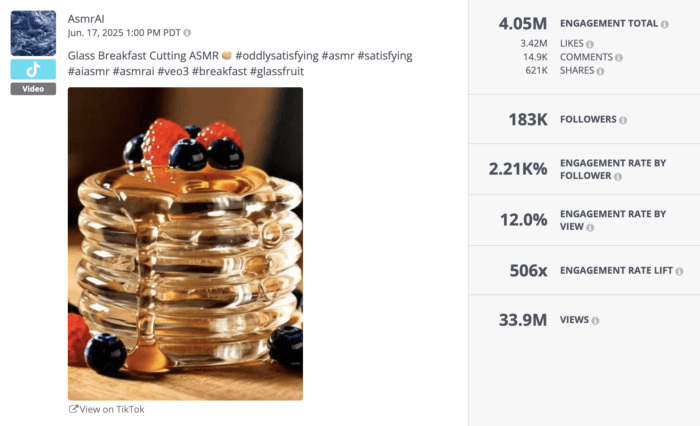
The AI-generated “glass breakfast” video from @asmraiworks reached 33.9M views and garnered 4.05M engagements (12% engagement rate by view).
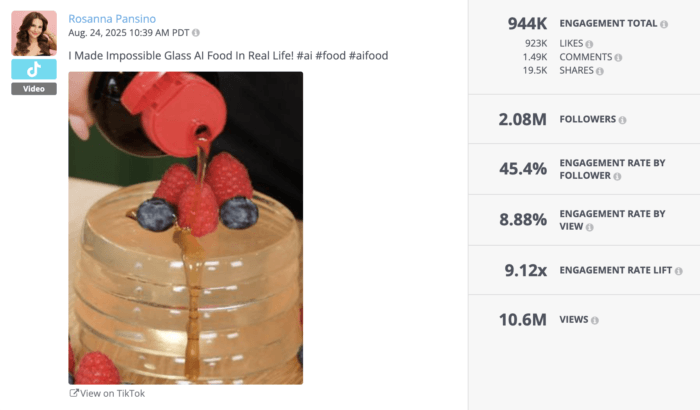
Pansino’s recreation of the same concept reached 10.6M views and 944K engagements (8.88% engagement rate by view). In this case, the AI video outperformed on both views and engagement.
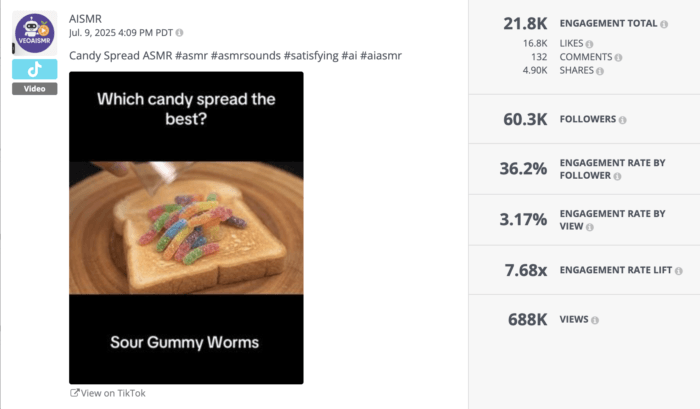
But the opposite happened with the “candy spread” trend. The AI video from @veoaismr generated 688K views and 21.8K total engagements for a 3.17% engagement rate by view.
Pansino’s recreation of the surreal video significantly outperformed the AI original. It reached 3.77M views and 437K engagements, resulting in an 11.6% engagement rate by view.
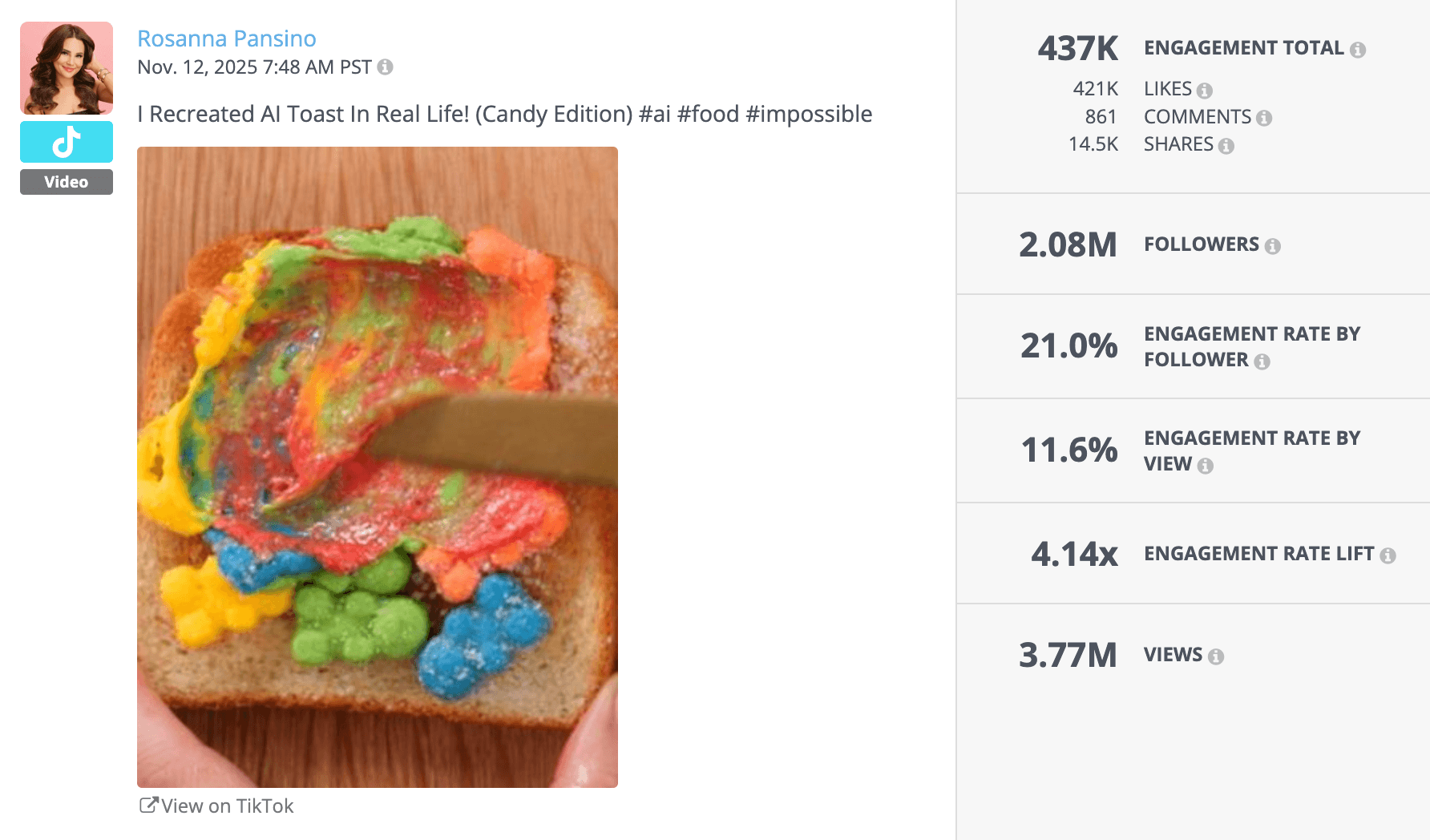
So in one instance, AI wildly outperforms. In the other, human creation drove higher engagement, suggesting that AI video success isn’t easily predictable or a surefire thing.
Of course, we can’t draw sweeping conclusions. Ultimately, performance likely comes down to your audience. Some users are drawn to AI-generated content, while others actively reject it in favor of human-made content. And because platforms reward engagement above all else, both reactions can drive good results.
What we can say is yes, AI video can absolutely perform well. But whether it should be part of your strategy depends on your audience, your goals, and your tolerance for the risks that come with it.
Wrapping It Up
AI-generated videos are reshaping social feeds in real time. And as the line between human-made and AI content blurs, gut instinct won’t be enough to guide strategy. This is where social analytics really matters.
The AI hype is hard to ignore, but the real story is in the numbers. Who’s actually engaging with AI content? How often? And does that engagement translate into sustainable success? Tools that track engagement, analyze sentiment among your audience, and give you insights into how competitors are performing with AI-generated content can help give you those answers.
At the same time, decisions can’t be based on metrics alone. Legal uncertainty, ethical concerns, and declining audience trust all play a role. The brands that come out ahead won’t be the ones chasing every shiny AI trend. They’ll be the ones measuring carefully, staying transparent, and balancing creativity with responsibility.
